Sunil Yadav has run the same tea stall outside Churchgate station for nineteen years, and in that time he has raised his price four times. Economists at the central bank adjust their models eight times a year. Sunil adjusts his when he has absolutely no other choice, because every rupee he adds sends a dozen regulars to the cart down the road.
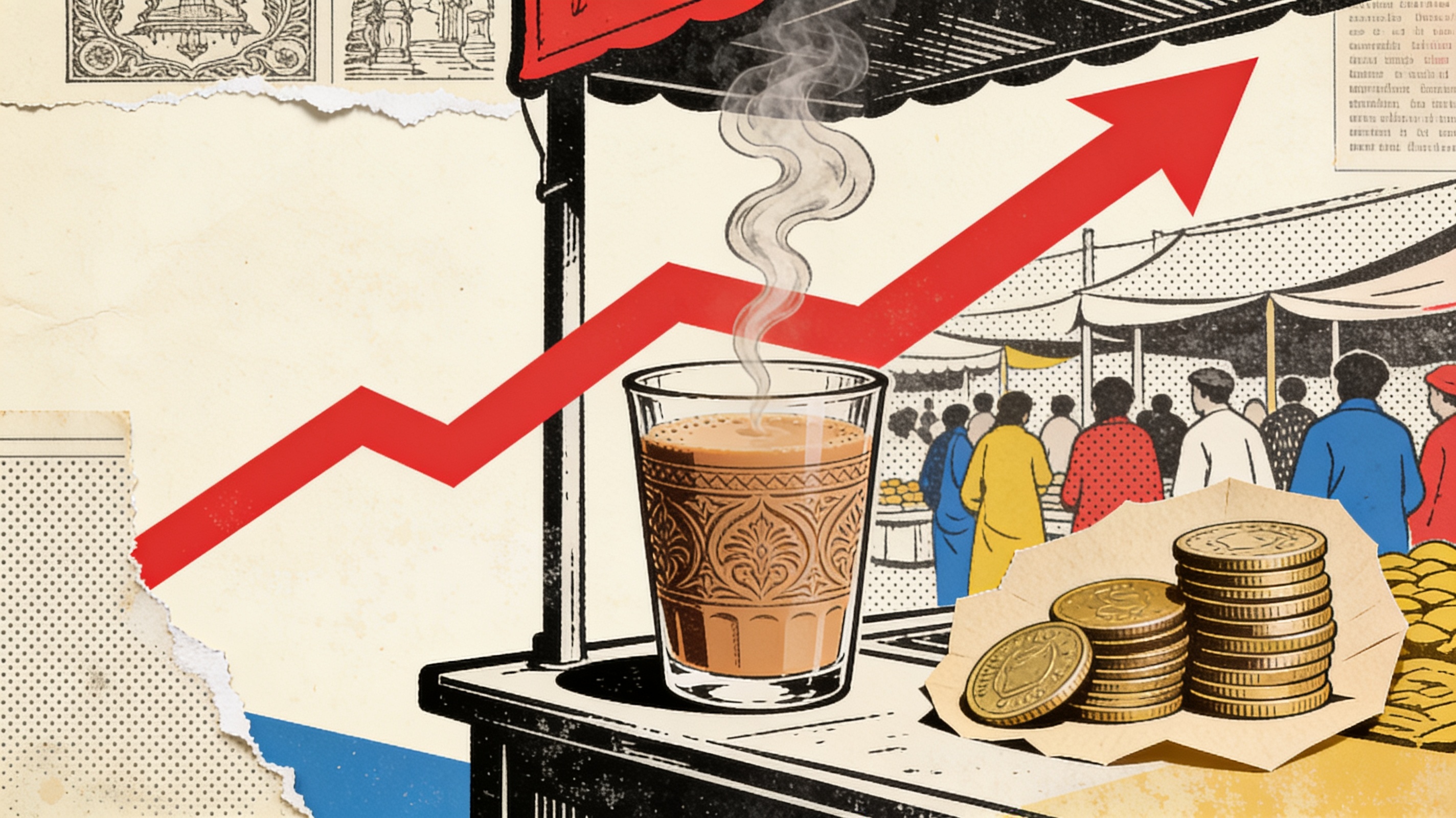
Which is why the number chalked on his stall is one of the most information-dense prices in the Indian economy. It just went from ten rupees to twelve.
The stickiest price in India
Official inflation is measured by a basket of 299 items surveyed across a thousand markets. The cutting chai compresses most of that basket into one glass: milk (the largest household food expense in India), sugar, tea leaves, LPG, rent for six feet of pavement, and the daily wage of the boy who washes glasses. When the glass price moves, it means every input has moved far enough that the most price-sensitive vendor in the country could no longer absorb the squeeze.
Economists have a name for prices like this — sticky prices — and a literature on why they matter: they move late, but when they move, they move honestly, and they do not move back.
The RBI publishes its inflation target. Sunil Yadav enforces his own: the price at which nobody walks away.
What twelve rupees is saying
The jump from ten to twelve is a 20 percent move in a price that held through five years of headline inflation. Talk to tea vendors from Borivali to Bhubaneswar — as this desk did, forty-one stalls’ worth — and the story is consistent: milk did it. Fodder costs, a patchy monsoon in the dairy belt, and procurement-price revisions stacked up until the glass gave way.
The chai index also explains why kitchen-table inflation feels worse than the printed number. Households do not consume the weighted basket; they consume milk, and milk has outrun the index for three years.
The dosa corollary
Regional cousins confirm the signal. The Bengaluru darshini’s idli-vada plate, Kolkata’s earthen-cup bhaanr, the Chennai filter coffee tumbler — all have breached long-held price points within the same two quarters. When four unrelated street staples reprice together, the models eventually agree with the pavement.
The central bank’s next review will parse core and non-core, base effects and momentum. Sunil has already published his findings, in chalk.