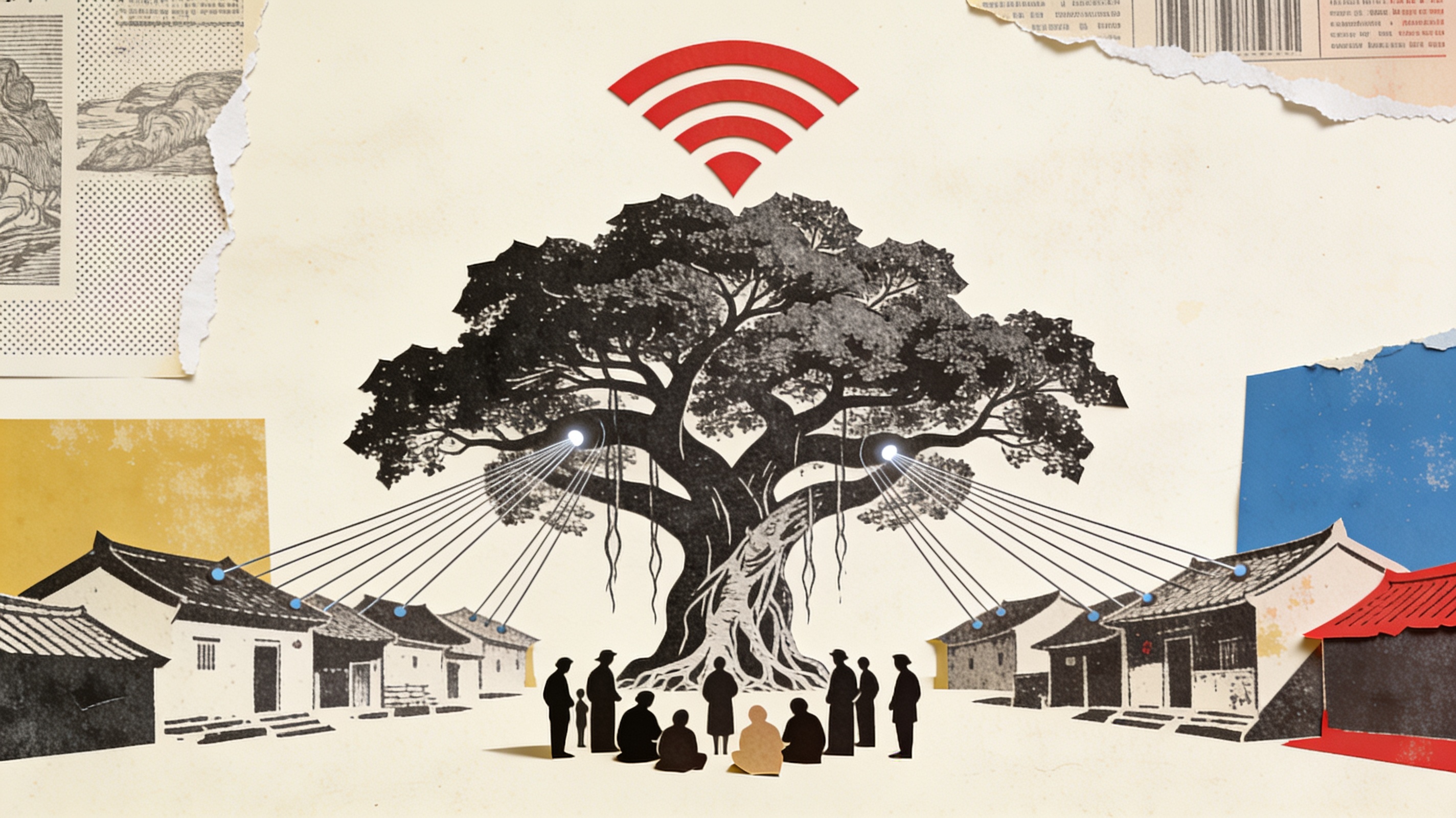
The sarpanch of a village in Odisha’s Ganjam district runs her government from a WhatsApp group, a solar-powered common service centre, and a dashboard that shows every water pump, pension, and school meal in her jurisdiction in real time. Her block development officer, forty kilometres away, still files reports on paper.
This inversion — the village more digital than the bureaucracy above it — is the unplanned consequence of the largest rural fibre project on earth, and it is quietly rearranging who actually governs rural India.
The pipe and what flowed through it
BharatNet’s two decades of missed deadlines made it a national punchline; its slow-motion completion has made it infrastructure history’s favourite redemption arc. With most gram panchayats now fibre-connected and last-mile Wi-Fi riding on top, the pipe finally exists. What flowed through it surprised the planners.
The design imagined citizens consuming services: certificates, payments, telemedicine. All of that happened. But the heavier traffic runs the other way — villages producing records. Land surveys by drone, attendance by face, works-progress by geotagged photo. The panchayat, once the last and least-informed tier of the state, has become its primary sensor.
For seventy years, information about villages travelled upward on paper and came back as policy. The direction just reversed.
Power follows bandwidth
Political scientists tracking the shift describe a subtle transfer of leverage. A sarpanch who can screenshot the fund-release dashboard no longer petitions the block office; she cites it. Social audits that once required an activist with an RTI application now require a phone. In several states, panchayat-level data has begun contradicting district reporting — creating friction the system was never designed to metabolise, and accountability it was never designed to survive.
The darker patterns arrived on the same fibre. Surveillance of who attends which meeting. Dashboards that measure everything and explain nothing. The old rural power structures have not dissolved; some have simply learned the new interface faster than their constituents.
The next Republic Day
The constitutional promise of panchayati raj — local self-government, not local implementation of distant government — has waited three decades for an enforcement mechanism. It may have finally found one, not in an amendment but in asymmetric information.
The republic was designed from Delhi outward. The bandwidth now runs the other way.